Per-ticket vs. flat-rate pricing: what's right for a Shopify store
We compare the two most common pricing models in ecommerce support based on the criteria that actually matter to a Shopify store: seasonality, variable volume, and predictability.
Adriana Vallejos
Marketing Analyst & Editor at Helpium
When you evaluate an AI-powered support tool for your Shopify store, at some point you'll run into two different pricing models: per-ticket pricing (or per resolved conversation) and flat-rate pricing.
There's no universal answer - it depends on how your store sells. But there are concrete, ecommerce-specific criteria that help you decide. Let's go through them one by one.
Criterion 1: Spending predictability
Per-ticket pricing: your support bill varies every month because it depends on how many conversations you generate, and that depends on how much you sell. It's hard to budget for in advance.
Flat-rate pricing: you pay the same every month, regardless of whether you generated 500 or 5,000 conversations. It's a cost line you can plan like any other fixed expense in your operation.
Who this matters most to: any store that builds a monthly or quarterly budget and wants to avoid surprises in operating costs.
Criterion 2: Seasonality and demand spikes
No Shopify store sells the same every month. There are dates (Black Friday, Cyber Monday, Hot Sale, Christmas) when order volume - and support inquiries - multiply.
Per-ticket pricing: in those months, your support cost multiplies in the same proportion as your sales. It's, literally, the worst possible time for your operating cost to spike, because it's when you need margin the most.
Flat-rate pricing: demand spikes don't touch your bill. You can handle double or triple the inquiries in your best month without that changing what you pay.
Who this matters most to: any store with noticeable seasonality, which is practically every Shopify store.
Criterion 3: Team size and growth
Per-ticket pricing: since it doesn't charge per seat, in theory you can add people without a direct extra cost. But the total cost is still driven by conversation volume, not by how many people you have handling it.
Flat-rate pricing with unlimited seats: you can bring in your whole team - support, logistics, marketing when you need an extra hand during peak season - without every new person being a financial decision. There's also no incentive to limit who can jump in and resolve a conversation.
Who this matters most to: stores where several people (not just a dedicated support team) need to step into conversations from time to time.
Criterion 4: Volume that varies month to month
A store that's just starting out and one that's already selling strong have very different conversation volumes, and that volume can vary a lot from one month to the next due to campaigns, launches, or seasonality.
Per-ticket pricing: it adjusts "downward" in slow months, which can sound attractive if your volume is generally irregular and low.
Flat-rate pricing: makes more sense for stores that already have (or project) a sustained conversation volume, because it dilutes the fixed cost across more resolutions and avoids overpaying in peak months.
Who this matters most to: it depends on your stage. Very small stores with low, stable volume may not notice the difference much yet. Growing stores with seasonality are the ones that benefit most from flat-rate pricing.
Criterion 5: How "real" the AI resolution actually is
A point that doesn't depend on the pricing model, but is worth evaluating alongside it: does the AI you're paying for use real data from your orders, or does it answer with generic templates?
An AI that only answers FAQs with fixed text doesn't resolve a "where's my order?" inquiry- it needs to query your system, check the actual shipping status, and respond with that information. That's what we call AI Actions at Helpium: AI connected to your Shopify store, able to query and act on real data, not just respond from a script.
It's worth asking before you compare prices, because a ticket "resolved" by an AI that can't check your actual order ends up escalating to a human anyway — and that's when you end up paying twice.
Summary table
Criterion | Per-ticket pricing | Flat-rate pricing |
|---|---|---|
Spending predictability | Low — varies with volume | High — same cost every month |
Peak season impact | Cost spikes along with sales | No impact on the bill |
Adding people to your team | No per-seat cost, but the total is still tied to volume | Unlimited seats included |
Stores with low, irregular volume | Can turn out cheaper | May not be justified yet |
Growing or seasonal stores | Risk of unpredictable bills at peak | Built to absorb spikes without surprises |
In short
If your store has noticeable seasonality, a growing team, or you'd simply rather stop looking at your support bill with uncertainty every month, flat-rate pricing with unlimited seats tends to be the option most aligned with how a real ecommerce business sells.
Keep in mind that Helpium doesn't charge extra per resolved ticket, but each plan has an AI message limit, and there's always a plan option suited to your volume. For more information, get in touch with us
AI-powered support without AI-powered pricing
Unlimited seats. One flat price. Serve customers with AI and a human team when it matters.
Keep reading

Do You Run a Real Estate Agency and Want to Automate Showing Coordination? Here's How
Every unanswered message is a showing going cold. We show you how to automate showing coordination without losing control of your calendar, so no lead falls through the cracks due to a slow response.

One inbox for everything: stop jumping between apps to answer customers
Your team doesn't lose time answering customers. It loses time figuring out where the conversation is, which channel it came in on and what was said before. A unified inbox removes that invisible cost.
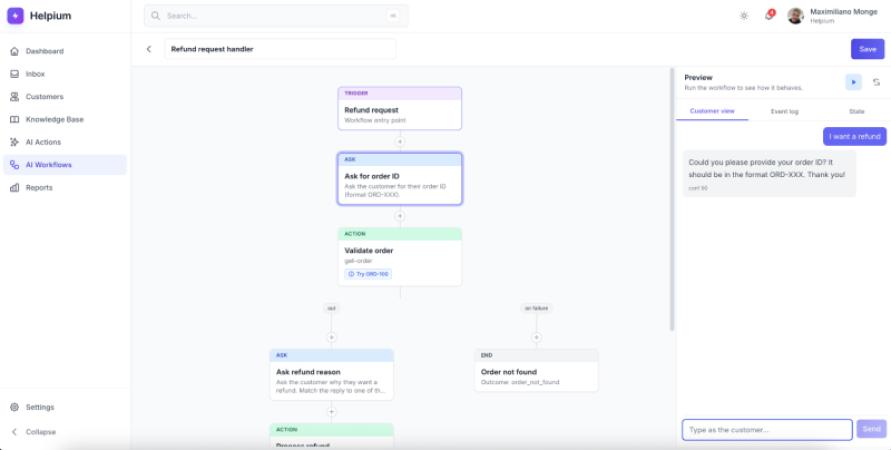
Helpium AI Workflows in action: handle refunds, track packages, and welcome new visitors
Every support team has the same five conversations on repeat. Helpium Workflows turns them into recipes the AI runs for you. Here is what the shipping presets actually do.